

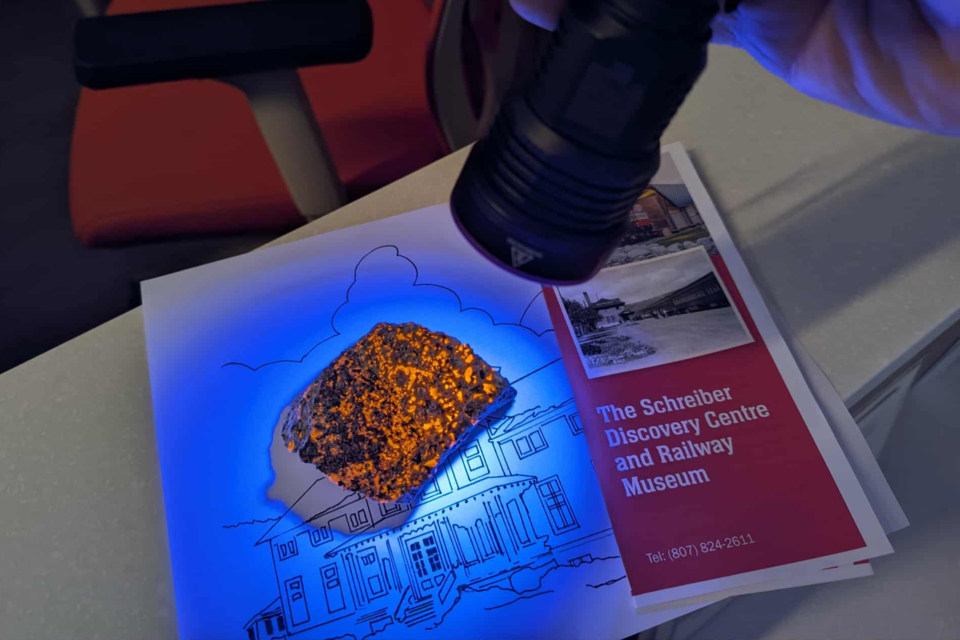
It is like nothing I have seen before on the back roads. Except for Sasquatch.
It was after midnight, and we were back a few kilometres on a back road east of Terrace Bay and Neys Provincial Park, not so far from the Lake Superior shoreline.
We pulled up to a solid logging-type bridge spanning a small creek and got out of the truck. On go the normal camping headlamps. Down the bank and under the structure like trolls we go.
Then a transition, off goes the camping, on goes the needed long-wave UV or black lights. The beams scan the bottom of the creek bed, back and forth. The shallow water looks like milk because of the lights. And then, like magic, illuminating the bottom, there are the fire rocks or yooperlites. The water is alive with a flaming lava colour and a glow. It is way better than the videos.
Where?
Yooperlites is a colloquial term. The bastardization of this word comes from a 2018 mineral discovery. (Denizens of Michigan's Upper Peninsula are regionally known as "Yoopers", a corruption of the abbreviation,
"U.P." for Upper Peninsula.) Anyway, America!
That year, US media and lapidary aficionados reported the discovery of a new “mineral” with the unofficial name of yooperlite.
Erik Rintamaki found the first fire rocks. He is a lifelong rockhound from Brimley, Michigan.
He explains on his website how in 2017 he was “picking the shores of Lake Superior at night using longwave UV lights,” and “made the discovery of a lifetime.’
He said, “Every rock picker’s dream is to find something new.”
What Erik found was later tested and verified to be syenites rich in fluorescent sodalite, which he branded “Yooperlites.” (So now we know.) These have now become a worldwide phenomenon with many, many articles and news stories written about them. He has been featured on many TV shows and YouTube features recently, including The Discovery Channel and The History Channel.
He says, “The best time of day to go is in the middle of the night. It's an unreal experience when your light brings a yooperlite to life with its distinct glow." He has found them along beaches, roadside rock cuts and gravel pits. Erik sells fire rocks and takes people out on tours.
To continue with the story. It is the fluorescent sodalite-bearing syenite which creates the fire rocks.
Then the rockhounds took over from near and afar.
Geologists surmised that the probable bedrock source is likely the Coldwell Alkaline Complex in Ontario. This region contains amphibole-natrolite-nepheline syenite within which the fluorescent mineral hackmanite, a sulphur-bearing variety of sodalite, has been identified. That might be a mouthful of rock terms, but it meant the yooperlites were not just an American anomaly.
The current theory is that pebbles and cobbles found along the Lake Superior shoreline of Michigan originated from this unit and were glacially transported to their current location, and subsequently wave-washed and tumbled. Let’s start looking north of the border.
Explanation
We are mesmerized, it is now well after midnight, and our enthusiasm is a thirst, only quenched with discovery.
The water is now alive and vibrant, the colours somewhere between a glowing orange or yellow.
It is similar to the pulsating colour created by an electric or gas-fired fireplace among the adorning rocks. Or the natural glow when you wait for the fire to turn to its “coal” base.
A yooperlite appears as a typical grey, speckled rock under normal daylight but transforms to a vibrant, glowing orange or yellow under ultraviolet (UV) light due to its fluorescent sodalite content. The intense, ember-like speckles create a dramatic effect, but the exact shade of the glow can vary depending on the specific mineral composition and concentration of sodalite within the specimen
How can this be?
Mark Hall is a geologist and a retired Landman from Sudbury. Yes, just like the Netflix series. Their responsibilities include researching property and mineral ownership, drafting leases and contracts, conducting title research, negotiating agreements with landowners, ensuring regulatory compliance, and acting as a bridge between landowners and companies. At one time, he was the Mining Recorder for the province of Ontario.
I asked him about the geologic formation termed the Coldwell Complex and why there is a preponderance of sodalite there. Stay with me, it is not so complicated, we mostly don’t understand geologic time and rock/mineral composition. Minerals are not rocks, by the way, or are they? Hmmm…
“It is a magmatic intrusion from deep in the crust. It happened when the North American continent started to split, but failed to complete. That was approximately a billion years ago. This particular intrusion was low in quartz, so at least parts of it are a syenite. If the chemistry is right, you get sodalite in these types of intrusions.” This intrusion also hosts lots of platinum and palladium, as well as copper and nickel.
He said syenite is a coarse-grained intrusive igneous rock “with a general composition similar to that of granite, but deficient in quartz.” So don’t be fooled by all that granite that is everywhere around us.
What makes the rocks illuminate? “Sodalite exhibits a phenomenon called fluorescence, which causes it to glow under ultraviolet (UV) or black light, typically appearing as bright yellow or orange patches or veins,” Mark said. “This happens because the sodalite absorbs UV light and re-emits it at a longer wavelength. A special variety of sodalite called hackmanite can also display tenebrescence, meaning it changes colour when exposed to UV light and then reverts to its original colour once the light is removed.”
Is there anything else other than sodalite? Mark explained, “Besides sodalite, common minerals like fluorite, calcite, and willemite are known for their fluorescence, but many other minerals, including aragonite, apatite, scheelite, and scapolite, can also glow under UV light. The glow is due to the mineral's ability to absorb ultraviolet (UV) light and re-emit it as visible light, a property often influenced by trace impurities within the mineral's crystal structure.”
Back Roads Ray
How this all started was that I was researching a pan northern Ontario small town museum piece, yet to be completed. I stopped in at Schreiber to visit their Highway 17 museum, featuring the CP rail front engine and joining passenger cars at the west end of the town between Terrace Bay and Rossport.
And what a museum it is, highly recommended. It is the transition into the future to attract younger visitors, and it embraces all the available technology. It is so entertaining, but then came the rock. More on that later, when that story comes to fruition, but fortuitously, I met Ray Gionet. He is the volunteer curator. He is one of those community spark plugs who gets things done.
The 37-year retired Bell employee, who moved to the CP town in 1980, showed me my first fire rock, without the light and then with the UV light. And Ray would say, “Back Roads Bill was hooked!” I said I would return, and two weeks ago, I was back again looking for Ray. We met outside Neys Provincial Park, where I was camping, and nighttime had arrived.
He explained his fascination. “I got started by seeing an article on the internet about Yooperlites. I figured if they are finding them in the States, they have to be here in Canada, too. I ordered regular blacklight flashlights, not knowing the difference. When my daughter arrived home from college, we tried our luck at Schreiber Beach. She found the first one immediately as we arrived at the beach. She commented that we forgot to bring a bag. Well, we walked the rest of the beach for hours to find no more.”
His enthusiasm for this infectious avocation is captured in this story. “The large holy grail of yooperlite rock cuts was probably my most exciting find. I found out from a retired OPP officer that he had come upon some vehicles that were parked on the side of the road with flashers on late at night. He pulled over to make sure they were ok. Turns out it was a university with students studying syenite rock formations with sodalite.
“They lit the rock cut up with UV lights, and it glowed like gold. With this new knowledge, I set out with a couple of friends to locate it. We were successful in finding it by having them hang out their windows, scanning highway rock cuts with their blacklights as I drove. I said, 'When you see it, you will know, just yell stop.' They both yelled at the same time as I applied the brakes, and they bailed from the truck. Goosebumps is what I remember the most. It was truly a sight to see.”
He underlined the following. “Now I know that the proper and most effective UV lights are the 365nm frequency blacklight.”
Pat and Dan, two new resident contractors, recent transplants from southern Ontario, came along on my recent visit. They were as excited as I was. Ray was the amenable and knowledgeable guide. (Remember I said I was looking for new adventures, wow, this is a keeper for sure.)
“Just like our trip, Bill, it never gets boring. It was great to start out with the teasers along the road, then larger ones at the pit. The rock cut was the definite treat. The rocks in the stream, a welcome bonus. Such a fun time in darkness! Appreciate you coming down, and Pat and Dan had a blast too and still talk about it.”
We went to a gravel pit, a highway bridge construction site (recently finished), the rock cuts and then the secret creek. I was sworn to secrecy. Here is a map, though, to get you started for some locations (not the creek spot, though – see the photos).
Finally
The real magic of the fire rocks is unlocked when they're displayed under UV. I am going to move away from the term yooperlites because they could be found anywhere, and we are still smarting from the tariffs. Fire rocks is the more Canadian name for them.
You will need that inexpensive 365nm longwave light, as referenced, and it works best for making that glow pop, but not all UV lights give the same results; just Google it. I bought two.
I asked Mark, the geologist, about other places in northern Ontario.
He said, because of the glaciers, "these could be found anywhere there is syenite.” That’s encouraging because there are a lot of gravel pits, rock cuts and cobble beaches in northern Ontario.
Just remember, syenite is not so common. “Relatively uncommon,” says Mark. “It looks like a granite with no quartz.” He said, though in another email, “We should be able to see some in Callander Bay (Lake Nipissing). Since it is shown on the map, there must be outcrop(s) of the stuff we can see.”
He’s excited. Looking forward to that, I am hooked on sleuthing out this stuff. And there is all that glacial till, so it could be here or there when you see exposed banks of cobbles.
Readers keep in touch. I would like to hear about your finds elsewhere in northern Ontario. The fire rocks are out there, alright.
You will want to order the small UV light (365nm – be sure) and not go to bed at 9:30. Well, anyway, the days are getting shorter in daylight duration.
Start looking at those rock piles on the back roads; there’s much to see and learn out there. Sasquatch, move over.